OpenVibe.Live
Open live-streaming platform: RTMP, WHIP and WebRTC ingest, multi-destination restream, VODs, clips, chat, live captions and translation. 529 routes, one engineer.
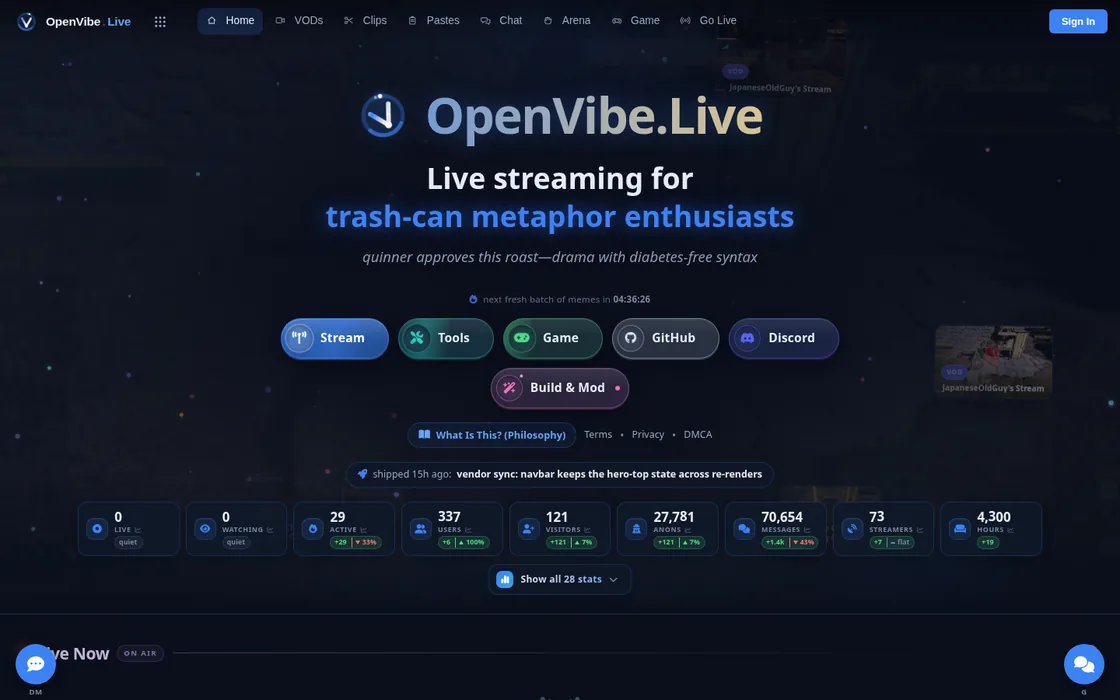
The flagship of the network and the reason the rest exists. Streamers connect OBS, an SRT encoder, a browser tab or a phone; viewers get a player, chat, clips and VODs that keep working while the server is being redeployed.
Ingest and delivery. RTMP, WHIP (open-CORS, so a backend-less web page can publish), a WebRTC SFU built on mediasoup, and a JSMPEG fallback. Restreams fan out through ffmpeg to Twitch, YouTube, Kick, custom RTMP and SRT destinations, and end with their source instead of lingering.
Media. Recording, clip cutting and thumbnails are delegated to OpenVibe.Media over a signed, multi-tenant API. VODs tier from local disk to Backblaze B2 and Cloudflare R2 and stream back through presigned URLs.
Community layer. Chat with moderation cascades, IP bans and redaction; a three-currency economy (OpenCoins earned site-wide, per-channel points, and Vibes for real-money support); voice rooms; watch-party song requests; a PowerChat integration with reconcile-and-retry webhooks.
AI, on a budget. A provider-agnostic LLM client (OpenAI, OpenRouter, Groq, Together, Ollama, llama.cpp) metered by a daily budget powers auto-clips, stream memories, timelines and site copy. Speech is transcribed locally with whisper.cpp and translated into about 21 languages, which is how a Japanese-speaking streamer became the site’s star.
Operations. systemd socket activation gives zero-downtime restarts (90 of 90 requests served through a full restart in testing). A deploy script classifies each change as static, server, dependency, schema or unit-level and takes the least disruptive path, with --wait-idle and --rollback. A CDP performance harness with interleaved A/B runs took the home page from CLS 0.83 to 0.03.